
Face Similarity Scores Explained — Accuracy, Thresholds and Limitations

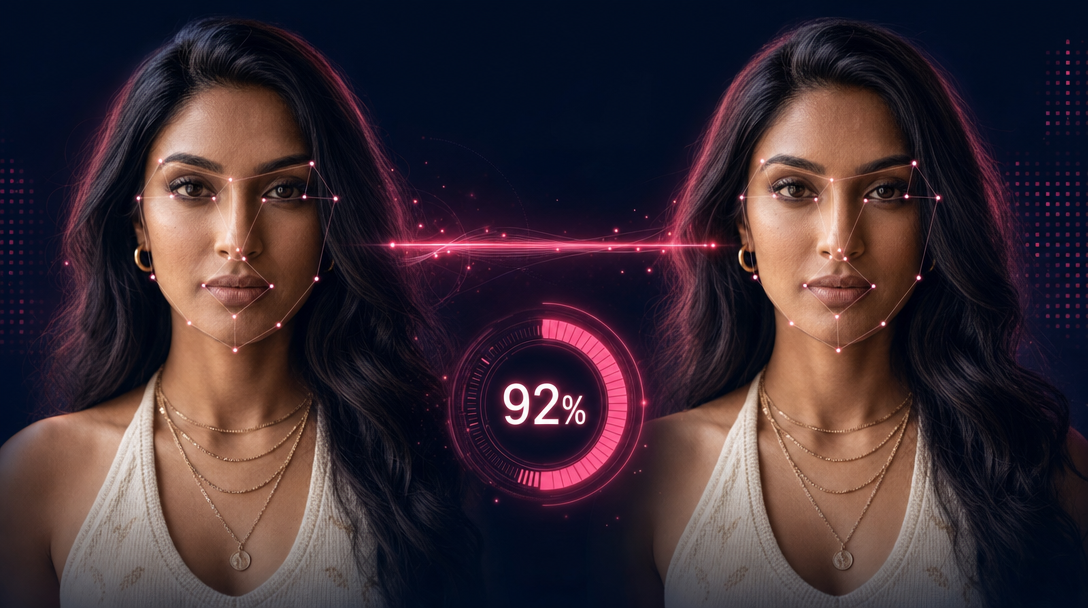
Abstract face similarity score gauge comparing two portrait silhouettes with a 72 percent readout
You ran a face comparison and got 72.4%. Good enough to ship, or time to regenerate? The number looks authoritative, but a face similarity score is not a courtroom ID. It is a relative readout from a face embedding model—useful for sorting AI portraits, storybook pages, and headshot variants, not for legal proof.
This guide explains how that percentage is calculated, how to interpret it, why scores shift between photos, and where browser-based face comparison stops being reliable. When you are ready to test images, compare two faces with the free checker and come back here to read the result.
Quick answer: A face similarity score estimates how closely two faces align in embedding space—not whether they are legally the same person. TheFluxTrain maps descriptor distance to 0–100% in your browser. Treat the number as a sort key against one reference, calibrate thresholds on your own project examples, then confirm by eye.
How does face similarity scoring work?
TheFluxTrain's Face Similarity Checker uses face-api.js locally in your browser. Each photo passes through four stages:
1. Detect — SSD MobileNet finds face bounding boxes. No face detected means no score.
2. Landmarks — A 68-point model marks eyes, nose, mouth, and jaw so tilt and scale do not skew the comparison as badly.
3. Embed — A recognition network outputs a 128-number vector (an embedding): a compact fingerprint of facial geometry learned from large training sets.
4. Compare — The tool measures Euclidean distance between reference and test embeddings, then maps it to 0–100%: similarity = max(0, min(100, (1 − distance) × 100)). If an image has multiple faces, the highest pairwise score wins.
This is relative distance in one model's space, not percent probability same person. Eighty-two percent on TheFluxTrain is not comparable to eighty-two percent on another vendor's tool. For production QA, use one scorer and one locked reference per batch.
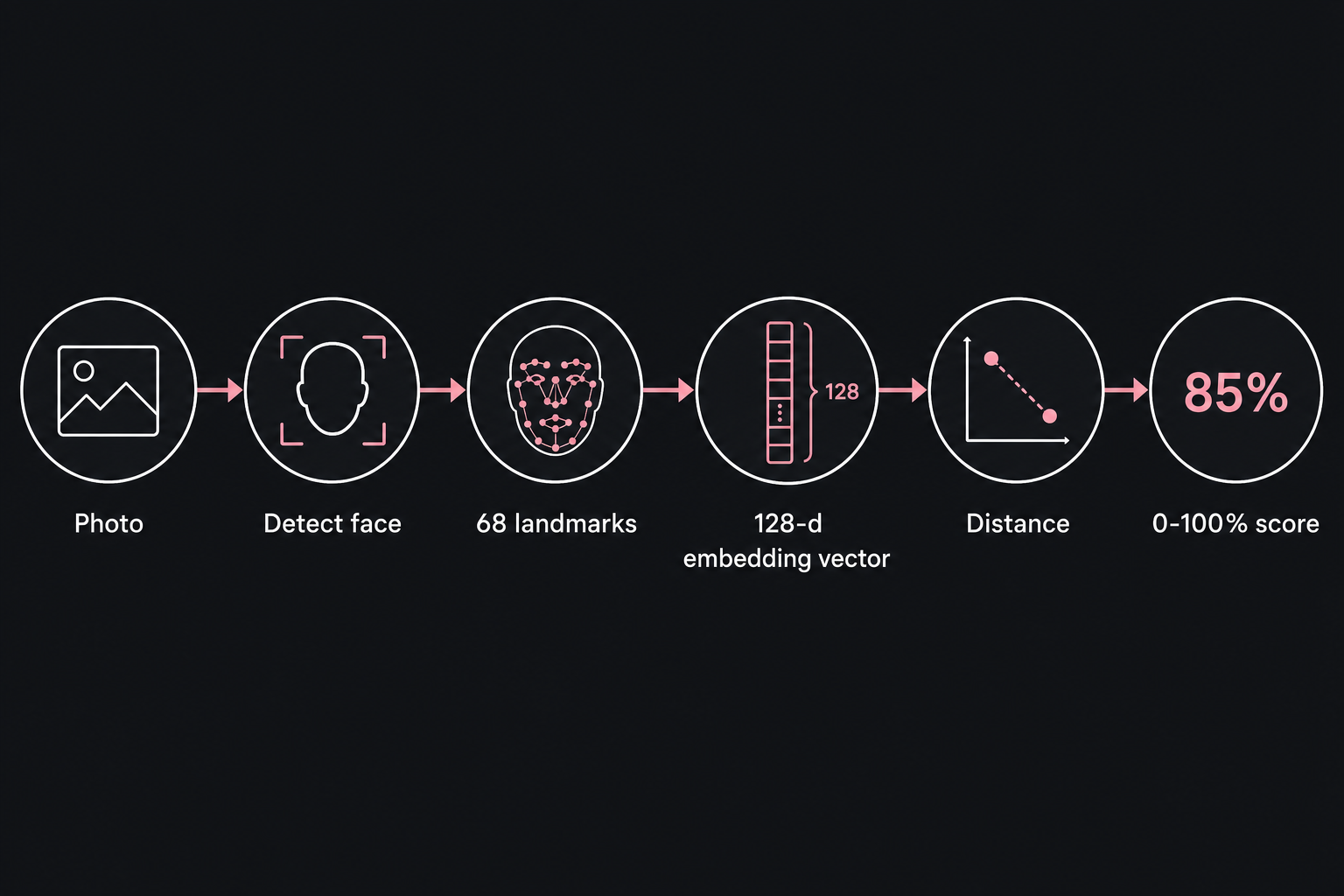
Each photo becomes a numeric embedding; the tool measures distance between vectors and maps it to a 0–100% readout—not a calibrated identity probability.
What does a face similarity percentage mean?
The percentage answers a narrow question: Which test image sits closest to this reference in embedding space?
It does not answer:
- Is this definitely the same person?
- Would a bank or government system accept this match?
- Is this image good enough to print without looking?
When I batch-check character stills, I stopped treating the score as a verdict. I use it to reorder a folder so the top matches get a full-size review first. That is the right mental model.
Face similarity and face match percentage are search phrases for the same continuous scale. Some products imply a binary yes/no at a cutoff; browser creative tools almost always show the raw percentage and leave the decision to you.
What is a good face similarity score?
There is no universal passing grade. Identity systems use strict calibrated thresholds you do not get from a free browser checker. Creative QA usually lives in a wider band that depends on art style, reference quality, and how picky your deliverable is.
| Use case | How to read the number | Practical approach |
|---|---|---|
| AI portrait QA | Rank ten variants; keep top two | Highest score in the batch, then eyeball at full size |
| Storybook / cartoon | Geometry matters more than skin texture | Relative rank beats absolute cutoff; stylized faces score lower than photos |
| Same-person photo sanity check | Quick gut-check before posting | High scores with matched lighting are reassuring—not sole evidence |
| Legal / security ID | Not appropriate | Do not use consumer embedding tools |
Relative ranking beats false precision. Generate eight AI portraits from one reference. Scores of 71%, 68%, 54%, 51% tell you the first two are your best bets—even if 71% feels low in isolation. Lock one reference image, score every variant against it, and advance the top matches to human review.
Want to test a pair or a batch now? Compare two faces with the free checker, then return to pick a threshold that fits your project.
Why do face similarity scores change between photos?
Embeddings encode 3D geometry from a 2D photo. Pose, crop, harsh shadows, smiles, glasses, and bangs all shift the vector—even when you instantly recognize the person. The same face might score high head-on and lower in profile.
Stylized AI art often scores lower against photo references because the metric is photo-biased. That does not always mean the image failed—compare AI variants against the same reference and trust relative rank. Re-score after any inpaint, face swap, or upscale that changes facial pixels.
Common score movers:
- Angle — Profiles and three-quarter views depress scores versus a frontal reference.
- Lighting — Harsh shadows and high contrast flatten embedding overlap.
- Crop — Tight crops that cut the jaw or forehead change geometry.
- Expression — Smiles and raised brows shift landmark positions.
- Accessories — Glasses, hats, and hair over the eyes.
- Art style — Illustration, watercolor, and heavy filters.
When a score surprises you, swap in a cleaner frontal reference and run it again before you reject the image.
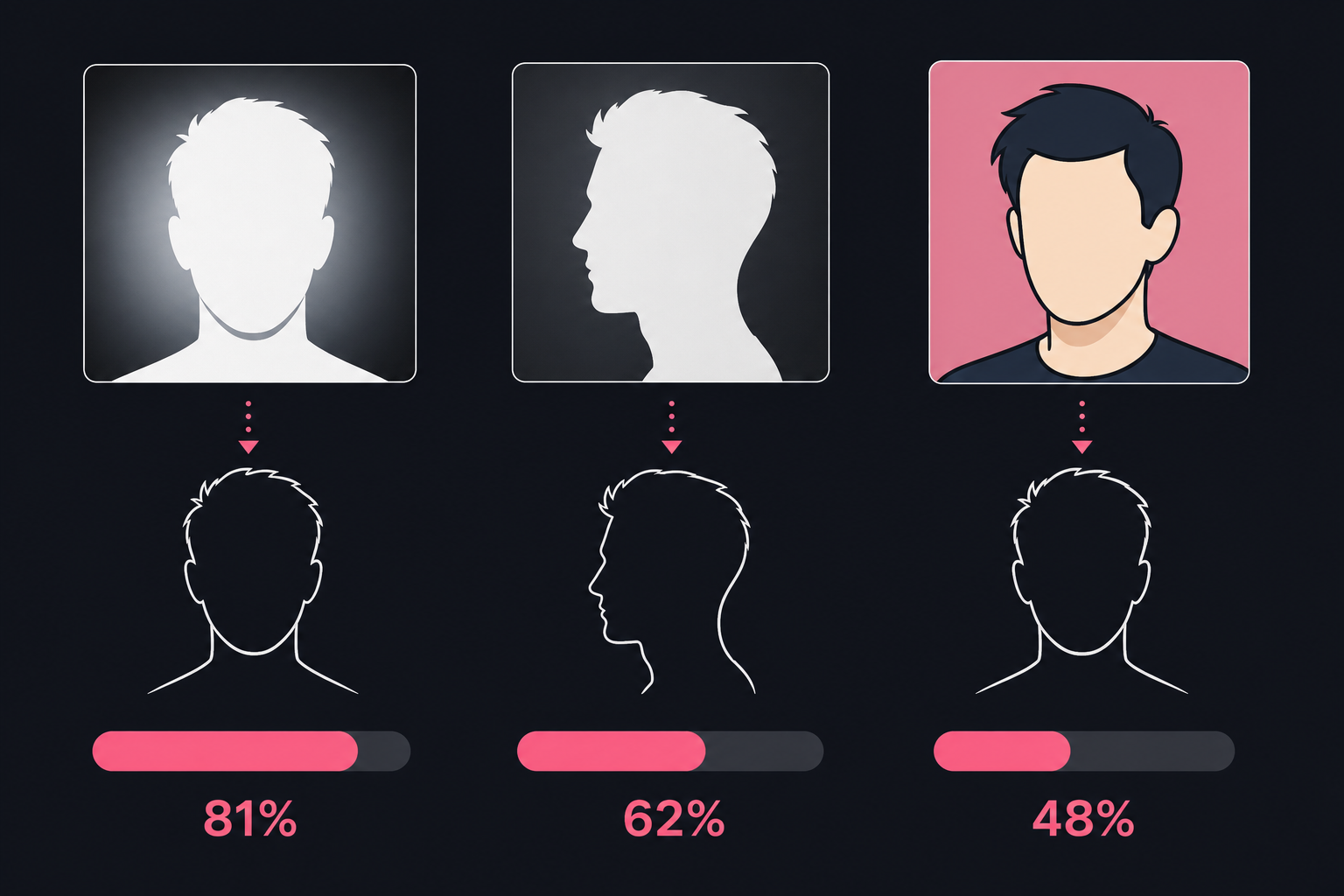
The same subject can score differently under frontal lighting, profile angle, or stylized art—compare rank within one batch, not across conditions.
How accurate is online face comparison?
Browser-based tools using established face recognition models are reliable for relative ranking within a batch—especially when you are picking the best AI portrait or sorting storybook exports. They are less reliable as standalone proof of who someone is.
Accuracy drops when:
- Faces are small, blurred, or partially hidden
- The subject is in profile or extreme perspective
- Multiple faces appear and the detector picks the wrong one
- The comparison set mixes photoreal and illustrated styles without calibrating expectations
For creative workflows, accuracy means did the tool sort my folder the way my eyes would? not would this hold up in court?
How should you choose a face similarity threshold?
Build a threshold from your reference set, not a blog table.
- Lock one approved reference photo.
- Score five to ten images you would definitely ship.
- Score five to ten you would definitely reject.
- Note where acceptable images cluster versus failures.
- Use that band as your project cutoff—and still review the top matches at full size.
Example workflow: one reference headshot plus six AI portraits come back at 81%, 76%, 68%, 54%, 41%, 38%. Keep the top two for retouching or video. Regenerate the bottom four with the same reference attached to your image model, rather than accepting close enough because one number crossed an arbitrary line.
Thresholds drift when you change art style, reference photo, or model. Re-calibrate when you switch from photoreal headshots to illustrated storybook pages.
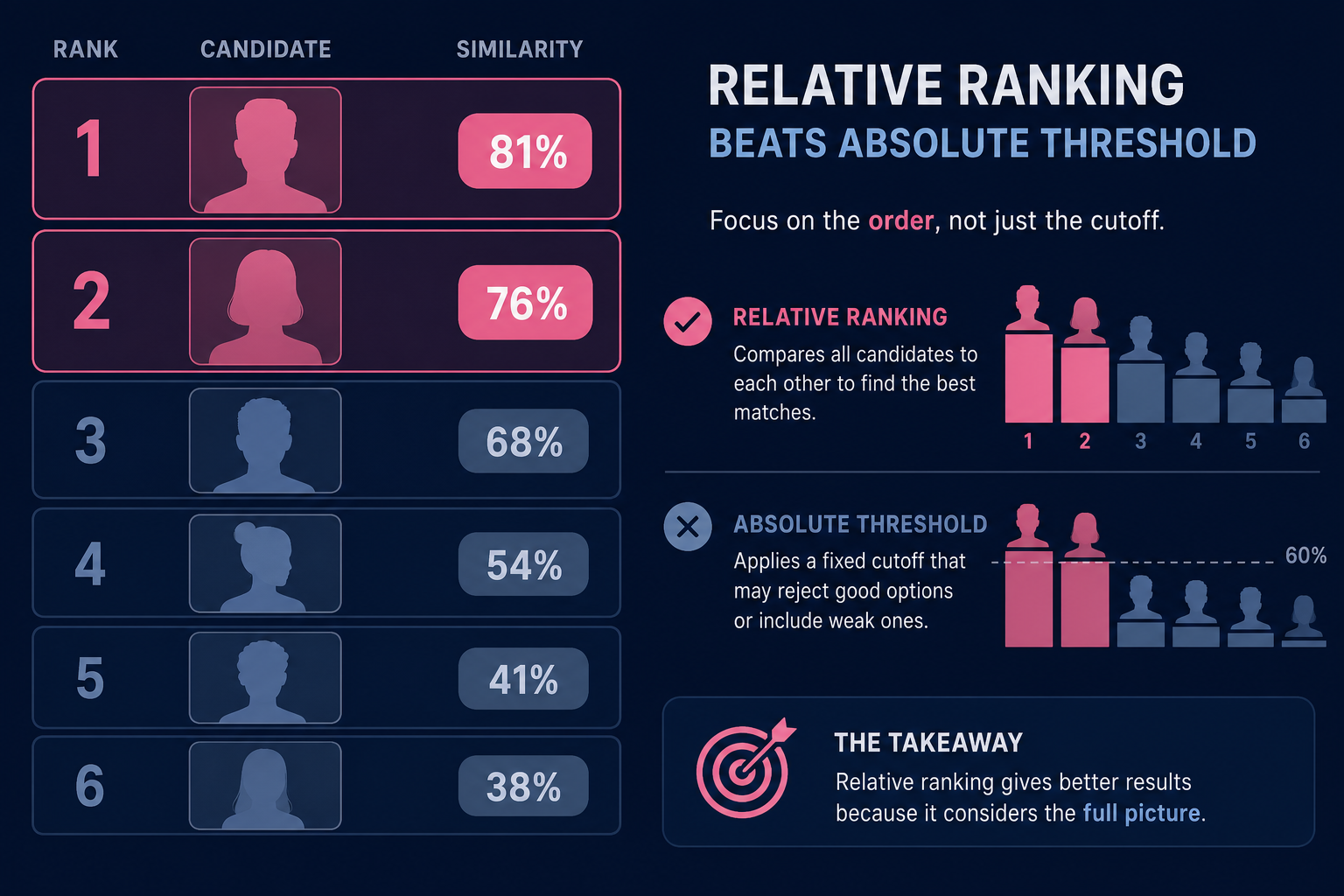
Relative rank within a batch beats chasing one magic number—keep the top matches, regenerate the long tail.
What are the limits of face match scores?
- Not comparable across tools. Different models and distance formulas produce different scales.
- Not legal identity proof. Do not use creative QA scores for fraud, employment vetting, or disputes.
- Group shots. The scorer may compare the best-matching detected face, which may not be your subject—crop to a single face when precision matters.
- No face detected. Small, blurred, or obscured faces return zero or unreliable results.
- Illustrated characters. Lower scores do not always mean the art failed; rank within the set and judge visually.
When in doubt, side-by-side review beats debating decimals.
How is face similarity different from facial recognition?
A face similarity checker ranks how alike your two photos look and returns a percentage; processing stays local in the browser. Facial recognition, the enterprise or government kind, matches faces against enrolled databases to answer who is this. TheFluxTrain's tool uses face-api.js on your device only. It is not ID verification.
Frequently asked questions
How does face similarity scoring work?
Each photo is detected, landmarked, and converted into a numeric face embedding. The tool measures distance between embeddings and maps it to a 0–100 percentage. Higher scores mean the faces sit closer together in that model's space—not a calibrated probability of identity.
What does a face similarity percentage mean?
It is a relative score from embedding distance, not proof that two photos show the same person. Use it to rank candidates against one reference, then confirm with your eyes at full size.
What is a good face similarity score?
There is no universal passing grade. Calibrate on your own reference set—note scores from images you would accept and reject, then rank new batches against the same reference. Relative rank within a batch usually matters more than chasing one magic number.
Why do face similarity scores change between photos?
Pose, crop, expression, hair, glasses, lighting, and art style all shift the embedding—even when you recognize the person instantly. Re-score every variant against the same locked reference and compare rank, not yesterday's absolute number.
How accurate is online face comparison?
Browser tools using established face recognition models are reliable for relative ranking within a batch, especially for creative QA. They are not reliable as standalone legal or security identity proof. Angle, blur, occlusion, and stylization all move the needle.
How should you choose a face similarity threshold?
Lock one reference, score a set of known-good and known-bad examples from your project, and note where your acceptable images cluster. Use that band as a project threshold—not a universal rule—and always do a human final check before you publish or print.
Is face similarity the same as facial recognition?
No. Face similarity ranks how alike two photos look and returns a percentage. Enterprise facial recognition matches faces against enrolled databases to answer who is this. Creative QA tools are not ID verification.
What are the limits of face match scores?
Scores are model-specific and not comparable across vendors. Group shots may lock onto the wrong face. Illustrated art often scores lower than photos even when it looks right. Never use creative QA scores for fraud, employment vetting, or identity disputes.
Next step
Compare two faces with the free checker, read your similarity score, and use the sections above to decide what it means for your project.
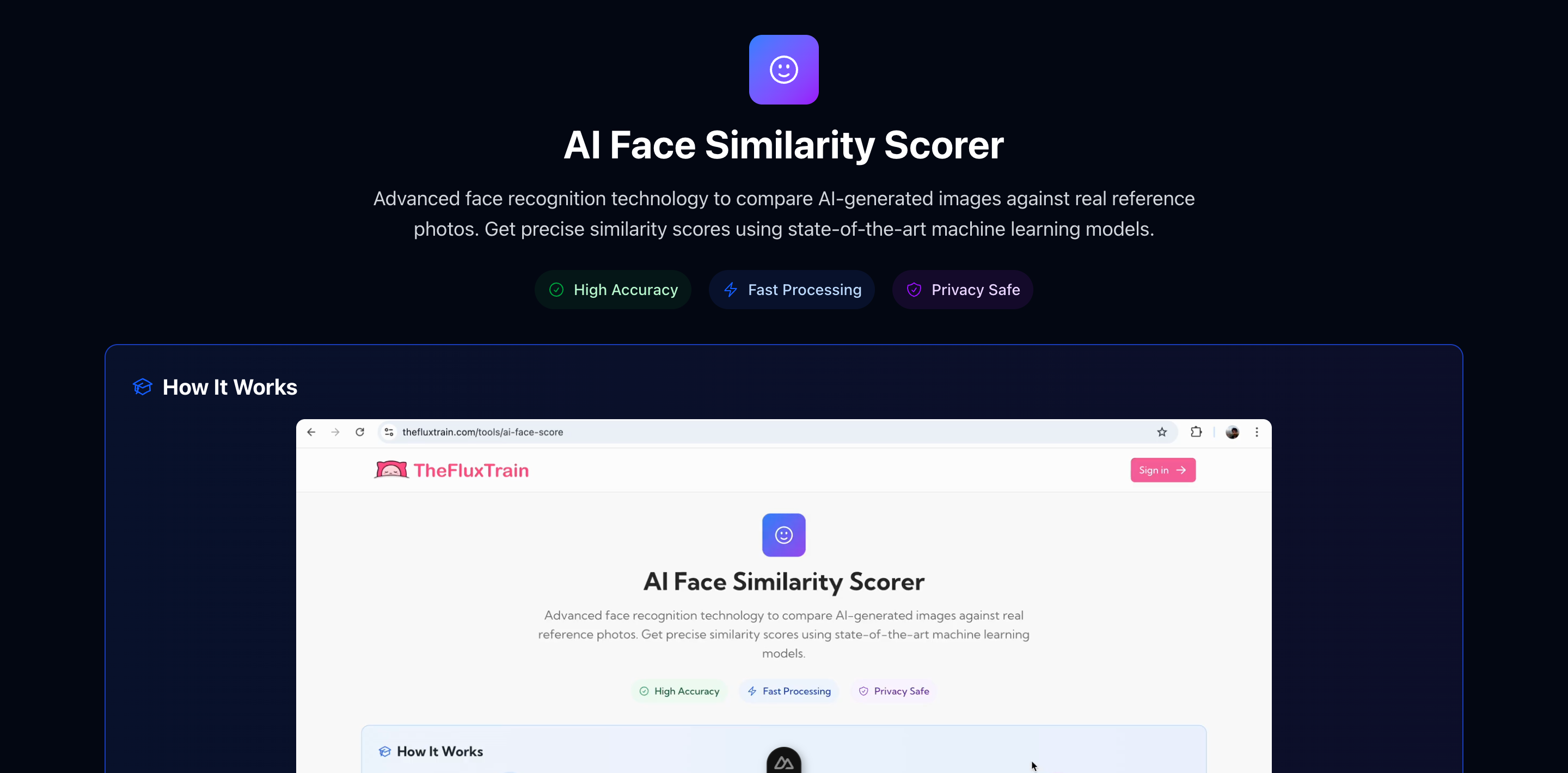
Run a pair or a batch in the checker, then return here to interpret the percentage before you ship.
More workflow depth is coming in dedicated AI art QA and storybook face-check guides—they all use the same checker; this page is where you learn to interpret the number.